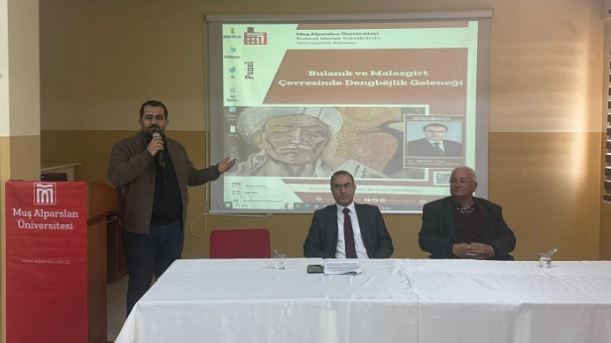
"Denbêjlik Tradition" Panel Organized in Bulanık and Malazgirt Surroundings
A delightful panel was held in our Vocational School, where Dr. Lecturer Nevzat EMİNOĞLU from the Department of Kurdish Language and Literature, Faculty of Arts and Sciences, MAUN, was the panelist with a presentation titled "Dengbêjlik Culture in Bulanık and Malazgirt" and Dengbêj Hasanê Lîzê from Bulanık performed dengbêjlik kilams (works).
Later, Dr. Lecturer Member Nevzat EMİNOĞLU under the title he presented "An important center of dengbej literature is the region called Serhad/Serhed or “Welatê jor/Upper country” in Kurdish, covering cities such as Bulanık, Muş, Ağrı, Erzurum, Kars. The oldest known representative of this line, which is known as Serhad dengbejlik and emerged as a school in dengbejlik, is the legendary dengbej Abdal-i Zeyniki. Erzurum Karaçobanlı Dengbej Reso and Bulanıklı Dengbej Zahiro are other great master poet dengbejs of this school who have crossed the country's borders. For this reason, Bulanık is one of the important and leading pillars of the Serhad dengbejlik school. The lively, active dengbejlik culture in Bulanık has also attracted many dengbej figures here. The legendary Dengbej Reso also spent a significant part of his life practicing his art in the villages of Bulanık. Reso moved to Bulanık with his family from 1951 to 1976. He settled in the villages of Xêrgîs, Arincîk, Koğak, Hoşgeldi, Piyong, Karaağıl and Gebolan in Bulanık and practiced his art.[12] He went to Anatolia for a while and settled in Gölmarmara, Manisa. He returned again in 1980 and this time settled in Pagê, one of the central villages of Muş. He died in 1983 and his grave is in the village of Pagê.[13] This cultural atmosphere has created the context for the production and development of dengbej literature, enabling Bulanık and its surroundings to become a center of this literary tradition," he said. In the last part of the panel, Eminoğlu concluded his words by saying, "Dengbej, an important area of Kurdish folk literature, is a culture and tradition that is quite vibrant and integrated with social life in Bulanık and its surroundings, as it is in the entire Serhad region. This tradition, which is based on an oral narrative tradition, creates social memory and memory, as well as being a source for oral history and the transmission of tradition. It is also an important dynamic that ensures a unity of language and emotion between individuals of the same society living in distant geographies. There are at least four or five dengbej in each village, more so in the center of Bulanık. Most of them are known in their own villages and surroundings and are at the level of local artists. However, there are also those in the city center and some villages whose dengbej quality has surpassed their villages and regions, and who have become famous in intercity, interregional and even international areas. Dengbej Ferzê, Dengbej Feqî Süleyman, Dengbej Şakiroyê Kopê, Dengbej Zahiro can be listed as a few of them. In Bulanık and its surroundings, there have been many dengbej who can vocalize masterpieces, as well as many “poet” dengbej who can write poetry and perform it as a dengbej piece. Some of these dengbej also graduated from the madrasah, which is the source of written Kurdish literature called “feqi” and “mela”, in other words, they are “teachers” and “students”. Some dengbej also benefit from written culture by writing works in the style of folk poetry and performing them in the form of odes and hymns. Such as Dengbej Feqî Süleyman, Dengbej Mela Halid, Dengbej Şakiroyê Kopê… This has added a different richness and quality to the dengbej of Bulanık. In Kurdish dengbej literature, Bulanik women dengbej have also made a name for themselves. Like Dengbej Bedewê, Dengbej Gulê... Armenian dengbej also emerged in Bulanik and its surroundings. Since ancient times, Armenians have lived as neighbors with Muslims in Bulanik and its surroundings. Since Kurdish was the general and widespread language of education and a common means of social communication in the madrasahs, which were the educational institutions of the period in the region, it was naturally learned and used by other communities," he concluded. Then, Dengbej Hesenê Lîzî showed the practical example and implementation of this literature with three exquisite dengbej pieces.